CBD for sleep: how to build a nighttime protocol without the guesswork
Sleep is not a luxury.
It is the body’s nightly repair system.
And when sleep breaks down, it rarely stays a nighttime problem. It follows you into the next day as brain fog, irritability, cravings, low resilience, pain sensitivity, and the quiet feeling that your nervous system never fully powered down.
At Healing Essence, we do not believe the goal is to be “knocked out.”
The goal is to feel supported down.
Not forced.
Not sedated.
Supported.
This guide will help you understand why sleep gets disrupted, where cannabidiol (CBD) and CBN may fit, how to choose the right format and timing, and how to build a simple nighttime ritual you can actually repeat.
We call it the restorative night protocol.
Because sleep works best when the body feels safe enough to soften.
The Healing Essence approach: the restorative night protocol
Most sleep content starts with the product.
We start with the pattern.
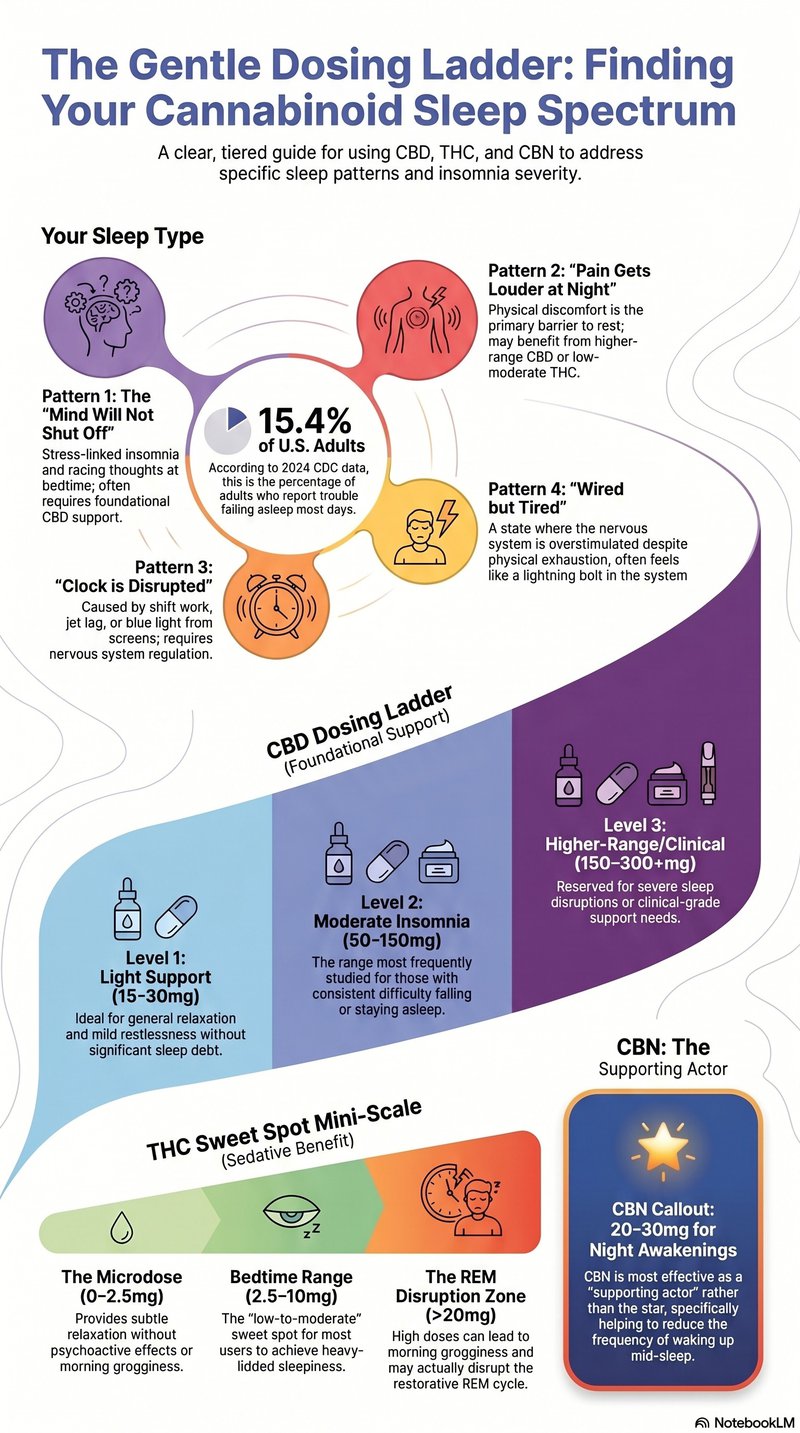
Because “I can’t sleep” can mean several different things:
- The mind will not shut off
- The body will not get comfortable
- The clock is disrupted
- The nervous system is tired, but still bracing
That’s why Healing Essence sleep support is not one-size-fits-all.
It is a protocol.
The restorative night protocol has three parts:
- Calm the nervous system: help the body shift from alert to at ease (a “downshift” in the central nervous system).
- Reduce the pain signal when pain is part of the story: because sometimes the sleep problem is actually a body discomfort problem.
- Make the routine simple enough to repeat: a ritual only works if it fits real life.
Why you cannot sleep: the 4 most common patterns
Sleep issues are rarely random.
Most fit into one of four patterns—or a combination of them.
Pattern 1: overthinking and stress-linked insomnia
The body is tired.
The mind stays on.
You replay the conversation.
You preview tomorrow.
You solve problems no one asked you to solve at midnight.
This is where many people first explore CBD for sleep because they are not looking for sedation.
They are looking for a softer landing.
This can also overlap with anxiety-related disorders, where the goal is not to “shut off” the mind, but to help the body feel safe enough to settle.
Continue here for a deeper walk-through: CBD for sleep aid and stress-linked insomnia.
Pattern 2: pain that gets louder at night
Pain has a way of waiting until the room gets quiet.
The knee you ignored all day.
The shoulder that carried the week.
The lower back that tolerated the chair until now.
Some people don’t have a sleep problem first.
They have a pain problem that becomes a sleep problem.
This is the Healing Essence architecture:
- Sleep is the symptom pillar
- Pain is the hidden disruptor pathway
- Topicals are the localized support bridge when the body will not settle
If discomfort is part of what keeps you awake, your sleep plan needs a pain plan too:
- Symptom guide: CBD for pain relief
- Local support format guide: How to choose the right CBD topical for local pain
Pattern 3: a disrupted clock
Sometimes the issue is not “you.”
It’s timing.
Shift work.
Travel.
Screens.
Late meals.
A body that doesn’t know whether it’s supposed to be awake or asleep.
CBD should not be positioned as a shortcut around basic sleep rhythm.
It should be positioned as one piece of a better landing routine (an adjunct to sleep hygiene, not a replacement).
Helpful next reads:
Pattern 4: the “wired but tired” nervous system
This is the person who is exhausted, but not calm.
They do not need more pressure to sleep.
They need fewer signals of threat.
Breathwork helps.
Light timing helps.
Caffeine boundaries help.
A consistent wind-down helps.
The right cannabinoid format may help some people too.
A supportive pairing for your bedtime ritual: CBD for sleep aid with meditation and breathwork.
Does CBD help with sleep?
The most honest answer is:
CBD may help some people sleep better.
Effects vary by person, product, dose, timing, and the reason sleep is disrupted.
The strongest real-life wins usually come when CBD is part of a repeatable routine—not treated like a one-night experiment.
For a grounded overview of what research currently suggests (and what’s still being studied), see:
Where CBN fits
CBN (cannabinol) is a minor cannabinoid often associated with nighttime calm.
Promising? Yes.
Popular in sleep formulas? Yes.
Fully settled science? Not yet.
Healing Essence positioning:
CBN is not a sleep switch.
It is a nighttime-support cannabinoid that may be helpful when paired thoughtfully with CBD, product timing, and a consistent routine.
Evidence-aware reading: Sleep Foundation: CBN for sleep.
The sleep format guide: what to take and when
Different formats have different jobs.
The better question isn’t “which product is best?”
It’s: what kind of night are you trying to support?
If you want a timing-first overview, start here: CBD for sleep aid: the best time to take it.
If you have trouble winding down
Choose a format that supports an evening transition.
A tincture can be a strong fit because it is flexible and adjustable.
Start here:
If you wake up between 2 and 4 a.m.
Choose a steadier, routine-friendly format.
Start here:
If gummies fit your routine better, you can also explore:
If pain is part of the sleep problem
Do not treat pain like a footnote.
Pain is often the thing making sleep fragile.
If the discomfort is local, add a topical.
Start here:
- Larger areas (back, shoulders, hips, legs): RESTORE body balm
- On-the-go, mess-free: RELIEF roll-on
- Smaller targets (hands, wrists, neck, knees): RESTORE twist up salve stick
And if you want the “format map,” read: How to choose the right CBD topical for local pain.
If you need fast support at bedtime
Some people explore cartridges because they want fast support in the moment.
Inhalation is not right for everyone.
If you have respiratory concerns, speak with a clinician before using inhaled products.
Start with education first:
Then, for a nighttime option:
Quick chooser: build your sleep protocol
| If your sleep problem is… | Start with… | Why |
|---|---|---|
| Mind will not shut off | CALM tincture or RELAX tincture | Flexible evening transition support |
| Waking in the night | RELAX capsules or CALM capsules | Routine-friendly, steadier support |
| Pain gets louder at night | RESTORE body balm or RELIEF roll-on | Localized support where the body is bracing |
| Need fast support at bedtime | Cartridge guide then CALM cartridge | Quick-onset downshift support |
| Unsure what fits | Free consultation | Personalized guidance without guesswork |
Move the phone out of reach.
Not because phones are evil.
Because your nervous system does not need one more thing asking for attention.
Step 2: drop the nervous system for two minutes
Try a simple breathing pattern:
Inhale slowly.
Exhale longer.
Repeat.
The exhale matters.
It tells the body the threat has passed.
If you want a guided pairing, use: CBD for sleep aid with meditation and breathwork.
Step 3: match the format to the pattern
Trouble winding down?
Choose a tincture.
Waking in the night?
Choose a steady format.
Pain keeping you awake?
Add a topical.
Need fast support?
Learn whether a cartridge is appropriate for you.
Step 4: treat pain as part of sleep
This is where most sleep content misses the point.
If the body is uncomfortable, the mind will keep checking on it.
So before bed, ask:
Where am I bracing?
Neck.
Jaw.
Shoulders.
Lower back.
Knees.
Hands.
Then apply support there.
That is the restorative night protocol in practice:
Calm the system.
Support the spot.
Let the body stop defending itself.
Dosing mindset: start low, stay present
There is no universal perfect dose.
There is the dose that supports you.
A gentle approach:
Start with the lowest practical amount.
Give it a few nights.
Notice how you feel in the morning.
Adjust slowly.
Do not chase more.
Look for enough.
(If you’re tracking, you can note your dose, timing, and next-day feel—simple “anxiety scores,” sleep quality, and morning clarity—so your protocol becomes repeatable.)
Quality and safety basics
Because CBD products vary widely, quality matters.
Look for:
- Clear labeling
- Third-party testing
- Certificates of analysis
- Transparent cannabinoid content
- A brand that can answer questions
You can review lab testing resources here: COAs.
It also helps to understand the basics: CBD (cannabidiol) is a cannabinoid from the cannabis plant. Most federally compliant products are derived from hemp plants (typically Cannabis sativa), not marijuana plants bred for higher concentrations of tetrahydrocannabinol (THC) and stronger psychoactive properties. Historically, the cannabis plant has been used since ancient times for fibers and oil, and today you’ll see different strains and chemotypes discussed (including cannabis indica and cannabis sativa as the 2 main species often referenced in consumer language).
CBD is not a magic fix for a plethora of ailments, and “better sleep” is a specific goal with a specific routine and (when needed) a clinician-guided clinical application.
When you research, prioritize high-quality sources (and yes—secure .gov websites can be a helpful place to start for general policy and safety context), and remember: many consumer claims still outpace controlled clinical studies due to federal research requirements. In other words, plenty of scientific publications exist, but sleep-specific conclusions can vary depending on the clinical population, the measured outcomes, and whether validated instruments were used.
If you’re looking at clinical application discussions in psychiatric literature, you may also see practical, real-world writeups from clinicians (for example, Scott Shannon, MD is sometimes cited in conversations about clinical practice and a retrospective chart review style of evidence)—which can be interesting, but is not the same as large randomized trials.
What makes Healing Essence sleep support different
Healing Essence is not trying to be another CBD brand with a sleep page.
The difference is the protocol.
The guidance.
The cannabinoid literacy.
The human support.
The symptom-first structure.
The connection between sleep, pain, stress, and daily life.
Not “CBD for sleep.”
CBD without the guesswork.
Frequently asked questions
Will CBD make me groggy?
Some people feel too relaxed if they take more than they need, take it too late, or choose a format that does not match their body.
Start low.
Adjust slowly.
Pay attention to how you feel the next morning.
How long does CBD take to work for sleep?
It depends on the format.
Inhaled formats may feel faster but often have a shorter effect window.
Oral formats like capsules, gummies, and tinctures may take longer to feel but can be better suited for a nightly routine.
For a timing guide: Best time to take CBD for sleep aid.
Is CBN better than CBD for sleep?
Not necessarily.
CBN is commonly associated with nighttime support, but it is less studied than CBD.
Many formulas pair CBD + CBN because they may support different parts of the sleep experience.
The better question is:
What sleep pattern are you trying to support?
What if pain is the reason I cannot sleep?
Then your sleep protocol needs a pain pathway.
If discomfort is local, consider adding a topical before bed.
Start with the topical chooser: How to choose the right CBD topical for local pain.
Can I combine a topical with a tincture or capsule?
Many people use different formats for different jobs.
A topical supports the spot.
A tincture, capsule, or gummy supports the broader nighttime routine.
If you are unsure how to combine formats, book a free consultation.
Can CBD products show up on a drug test?
Yes, they can.
Even when products are federally compliant, long-term use may result in a failed THC drug test depending on product, dose, frequency, and test type.
(And if you’re scanning psychiatric literature for sleep + cannabinoids, note that some discussions cite small samples or a retrospective chart review rather than large, randomized trials—so keep your “keywords” practical: product type, dose, timing, and outcome.)
Ready to build your sleep protocol?
Start with the path that matches your night:
- Stress and overthinking: CBD for sleep aid and stress-linked insomnia
- Timing and routine: Best time to take CBD for sleep aid
- Evening transition: CALM tincture or RELAX tincture (CBD + CBN)
- Nighttime support: RELAX capsules or CALM capsules
- Pain-related sleep disruption: CBD for pain relief
- Localized body support: Topicals guide
- Fast bedtime support: Cartridge guide and CALM cartridge
- Need help choosing: Free consultation
Sleep is not the end of the day.
It is where healing begins.
And you do not need to force your body into rest.
You can support it there.